
Mūgapakkha Jātaka
Mūgapakkha Jātaka
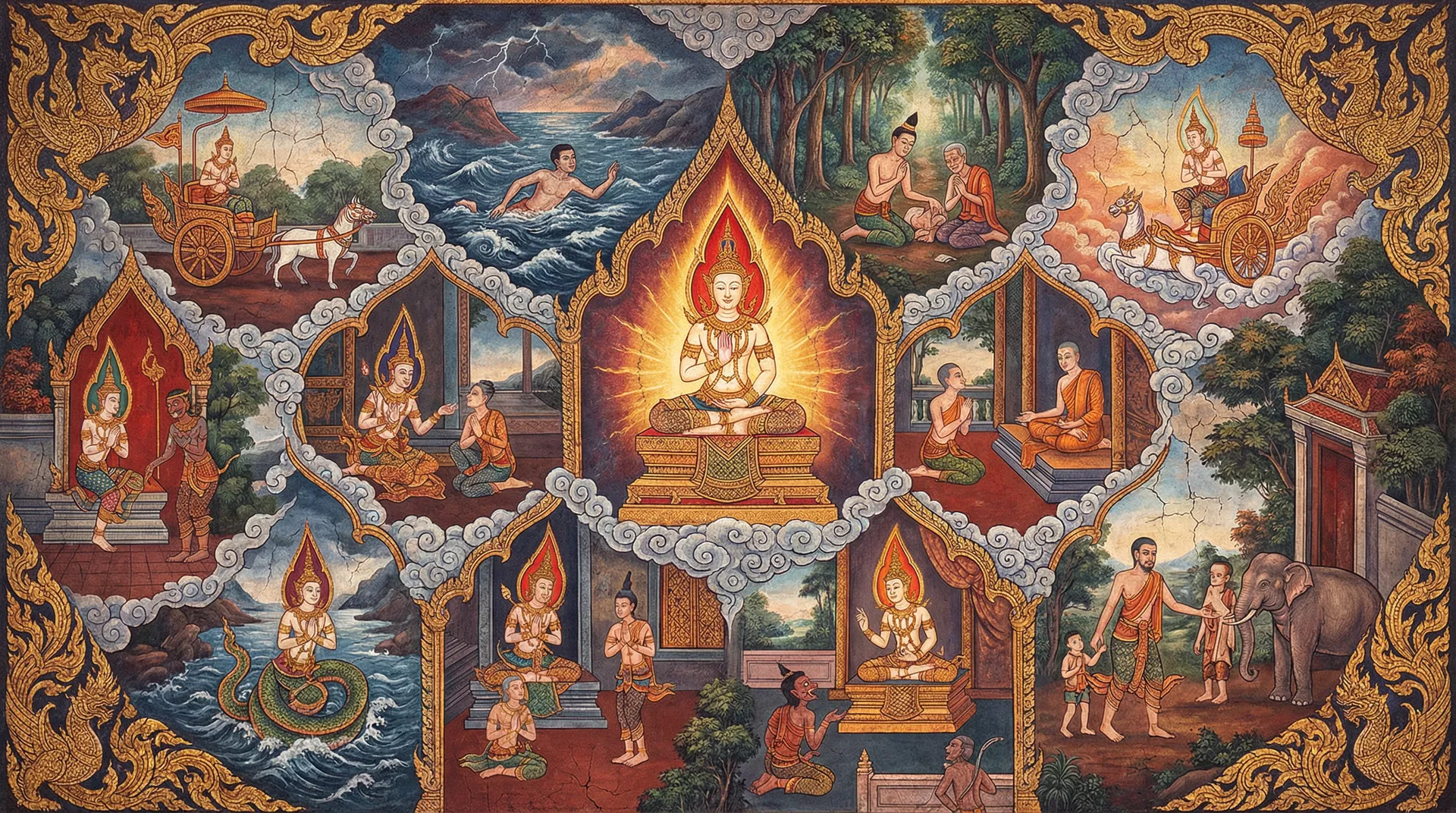
In the sun-drenched land of Mithila, ruled a king named Brahmadatta, a monarch whose heart was as vast and generous as the sky. Yet, a shadow loomed over his otherwise glorious reign – the king had a peculiar affliction: he was born mute. His voice, though his own, was trapped within him, unable to escape the confines of his throat. This silence, however, did not diminish his wisdom; his eyes spoke volumes, his gestures conveyed profound thoughts, and his actions demonstrated an unparalleled understanding of his kingdom's needs. The people of Mithila loved him dearly, understanding his silent pronouncements with a devotion that transcended mere words.
One day, a wicked Brahmin, consumed by envy and a thirst for power, arrived at the royal court. He saw the king's silence not as a challenge, but as an opportunity. This Brahmin, a master of deception, approached the king with a cunning plan. 'Your Majesty,' he began, though the king could not reply, his eyes piercing the Brahmin's every word, 'I possess a secret, a magical incantation that can grant the gift of speech. But it comes at a price. I must have access to the royal treasury, for the ingredients are rare and costly.'
The king, though unable to utter a sound, possessed a keen intellect. He observed the Brahmin closely, noticing the greed glinting in his eyes, the smugness in his posture. He recognized the snake in the grass, the wolf in sheep's clothing. He knew this man sought not to help him, but to plunder his kingdom. Yet, he did not reveal his suspicion. Instead, he nodded his head, feigning agreement. The Brahmin, mistaking the king's silence for simplemindedness, was overjoyed. He saw his path to riches laid bare.
The Brahmin, under the guise of preparing the magical elixir, began to pilfer from the treasury. He would take small amounts at first, then larger, his greed growing with each successful theft. He believed he was outsmarting the mute king, unaware that the king was merely playing along, observing and waiting for the opportune moment.
Meanwhile, the Bodhisatta, in a previous existence, was a wise elder in the king's court, a close advisor known for his sagacity and unwavering loyalty. He, too, observed the Brahmin's avarice. He saw the king's silent strategy and admired his patience. The Bodhisatta understood that the king was allowing the Brahmin to dig his own grave.
One evening, as the Brahmin, emboldened by his successes, was about to abscond with a particularly large haul of jewels, the king gave a subtle signal to his trusted guards. They had been watching, waiting for the perfect moment. The Brahmin was apprehended, caught red-handed, his deceit exposed for all to see. The king, with a flick of his wrist, gestured for the stolen treasures to be returned, and for the Brahmin to be banished from the kingdom, never to return.
The people rejoiced at the king's cleverness. His silence, which the Brahmin had seen as a weakness, had become his greatest strength. The king, through his astute observation and strategic patience, had protected his kingdom and exposed a villain without uttering a single word. The Bodhisatta, witnessing this, saw the profound truth: that true wisdom is not always loud; it often resides in quiet observation, in careful planning, and in the courage to act decisively when the moment is right.
— In-Article Ad —
💡Moral of the Story
True wisdom is revealed not through eloquent speech, but through careful observation, strategic patience, and decisive action.
Perfection: Patience (Khanti Paramita)
— Ad Space (728x90) —
More Jataka Tales You May Enjoy
 144Ekanipāta
Maca Hamsa Jataka
The Tale of the Golden Swan King In the realm of the Himalayas, amidst snow-capped peaks and crystal...
💡 True wealth lies in inner virtue, wisdom, and compassion, not in material possessions which are transient.
135EkanipātaVessantara Jataka
The Tale of the Generous Prince Vessantara In the kingdom of Siwi, ruled a wise and benevolent king....
💡 True generosity extends beyond material possessions; it involves the willingness to sacrifice even the most cherished aspects of one's life for the sake of others and one's principles.
86EkanipātaThe Great Vanga Jataka
Once upon a time, in the glorious city of Savatthi, while the Supreme Buddha resided at Jetavana Mon...
💡 True compassion lies in the willingness to sacrifice one's own well-being for the benefit of others, and such selfless acts can bring about miraculous positive change.
 547Mahānipāta
Mahāsutasoma Jātaka
The Tale of the Great Sutasoma In the city of Indapatta, ruled a wise and just king named Pāṭaliputt...
💡 The unwavering commitment to truth, even in the face of death, possesses a transformative power that can overcome the deepest darkness and bring about profound change.
142EkanipātaKusa Jataka
The Tale of Prince Kusa and Princess Pabhavati In the magnificent city of Kosala, ruled King Okkaka,...
💡 True beauty lies not in physical appearance, but in noble character, kindness, and virtuous deeds.
 176Dukanipāta
Mahāsuka Jātaka
Mahāsuka JātakaIn the ancient city of Mithila, nestled amidst lush gardens and bustling marketplaces...
💡 True happiness is not found in external possessions or fleeting pleasures, but in the cultivation of inner peace, wisdom, and virtue. The greatest treasure is the joy of a contented mind, free from the bondage of insatiable desires.
— Multiplex Ad —